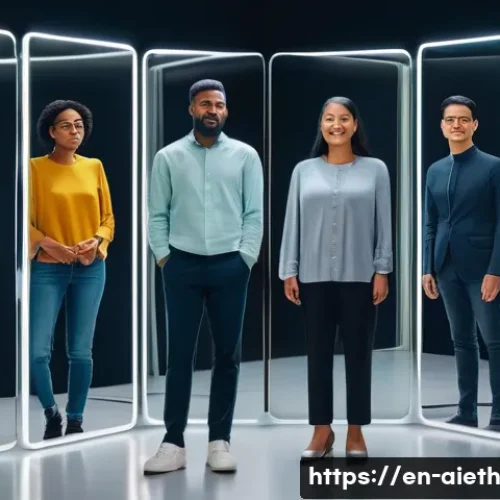
Beyond the Blueprint Unmasking the Real World Flaws of Ethical AI

webmaster

AI 윤리와 AI 윤리적 AI 비판 - **Prompt:** A diverse group of adults (various ages, ethnicities, and genders), all wearing contempo...

Artificial intelligence has officially transitioned from sci-fi fantasy to an integral part of our daily rhythm, quietly powering everything from our smartphones to life-saving medical systems.

But as these digital brains expand their reach and influence, I’ve found myself pondering a really critical question: are we genuinely building AI with a strong ethical foundation, or are we perhaps glossing over some serious cracks in the pavement?

The conversation around AI ethics is absolutely booming right now, and while many are tirelessly working to ensure AI is a force for good, there’s a compelling counter-narrative emerging – one that critiques our very approach to ethical AI itself.

It’s a complex, multi-faceted debate with massive implications for our future, and honestly, it’s one we all need to understand. Let’s cut through the noise and get to the heart of what’s truly going on with AI ethics.

The Elephant in the Room: Decoding AI’s Moral Compass

AI 윤리와 AI 윤리적 AI 비판 - **Prompt:** A diverse group of adults (various ages, ethnicities, and genders), all wearing contempo...

Beyond the Buzzwords: What We’re Really Talking About

It’s easy to get lost in the academic jargon when we talk about AI ethics. Terms like “fairness,” “transparency,” and “accountability” get thrown around a lot, almost to the point where they start to lose their meaning.

But when you strip away all the technical talk, what we’re really wrestling with is how to ensure these incredibly powerful tools align with our fundamental human values.

I’ve seen countless discussions where the focus is on drafting elaborate ethical frameworks, which are certainly a start, but sometimes I feel like we’re just ticking boxes rather than truly embedding ethical considerations into the very core of AI development.

It’s not just about preventing harm; it’s about proactively designing for good, understanding the societal impact before it hits us like a tidal wave.

Think about it – every line of code, every dataset chosen, every algorithm deployed, carries an inherent value judgment, whether we explicitly acknowledge it or not.

The choices made by engineers and designers today are literally shaping our collective future, and that’s a weight we absolutely must take seriously. It demands a level of introspection and foresight that goes far beyond a simple checklist.

The Shifting Sands of AI Responsibility

What often strikes me is how fluid the concept of responsibility becomes when AI enters the picture. When a self-driving car gets into an accident, who’s ultimately at fault?

Is it the software engineer, the sensor manufacturer, the car owner, or the AI itself? This isn’t a hypothetical question anymore; these scenarios are playing out in real life, pushing the boundaries of our legal and ethical frameworks.

I remember reading about a case where an AI system used in judicial sentencing exhibited clear biases, leading to disproportionate outcomes for certain demographics.

My immediate reaction was, “How could this happen?” But then, digging deeper, you realize it’s rarely a single point of failure. It’s a complex interplay of historical data, human design choices, and the inherent limitations of current AI.

It’s a messy landscape, and honestly, trying to pinpoint a single responsible party often feels like trying to grab smoke. We need clearer lines of accountability, not just for the sake of justice, but to foster trust in these systems that are increasingly intertwined with our daily existence.

Without that, public skepticism will only grow, potentially stifling innovation.

Where Our Data Meets Our Doubts: The Bias Battlefield

Our Data, Our Prejudices: The Inconvenient Truth

If there’s one thing I’ve learned about AI, it’s that it’s fundamentally a reflection of us – the good, the bad, and the downright ugly. We feed these systems data, massive amounts of it, and if that data is tainted with historical or societal biases, then guess what?

The AI learns those biases and, in many cases, amplifies them. It’s like looking into a digital mirror that doesn’t just show you what you look like, but also highlights all your flaws in glaring detail.

I’ve personally experimented with various image recognition tools that struggled with diverse skin tones, or translation software that defaulted to gendered pronouns in problematic ways.

These aren’t just technical glitches; they’re symptoms of a deeper problem within our datasets. It’s a humbling reminder that technology isn’t neutral; it’s shaped by human choices and, often, human blind spots.

The real challenge isn’t just identifying these biases – though that’s a huge first step – but actively working to mitigate them throughout the entire AI lifecycle, from data collection to model deployment.

It means challenging our own assumptions and really digging into the societal context of the data we’re using.

When Algorithms Decide: Fairness in Action (or Inaction)

We’re increasingly relying on algorithms to make critical decisions that impact people’s lives: loan applications, job interviews, even predictive policing.

And when these algorithms carry biases, the consequences can be devastating for individuals and entire communities. I once followed a story about an AI-powered hiring tool that systematically disadvantaged female applicants, simply because it had been trained on historical data that favored male candidates for technical roles.

Can you imagine the frustration, the feeling of being unfairly judged by a machine that’s supposed to be impartial? It’s infuriating! This isn’t some abstract ethical dilemma; it’s real people losing real opportunities because of flawed code.

The notion of “fairness” in AI is incredibly complex because it can mean different things to different people and in different contexts. Is it about equal outcome, equal opportunity, or something else entirely?

As users and as a society, we need to demand greater transparency and auditability for these systems, ensuring that “fairness” isn’t just a buzzword but an actionable principle, regularly checked and challenged.

It’s about ensuring these powerful tools don’t just perpetuate the inequalities we’re striving to overcome.

Advertisement

When Things Go Sideways: Navigating the Maze of AI Accountability

Tracing the Digital Footprints: A Developer’s Burden

Let’s be frank: when an AI system makes a mistake, whether it’s a minor error or a catastrophic failure, the finger-pointing starts almost immediately.

But unlike traditional software where you can often trace a bug back to a specific line of code or a developer, AI, especially with complex neural networks, can be a “black box.” This opacity makes establishing clear accountability incredibly difficult.

I’ve personally witnessed the frustration of teams trying to debug an AI model that’s delivering unexpected results. It’s not always about a coding error; it can be about data drift, adversarial attacks, or emergent properties of the model that no one fully anticipated.

So, when something goes wrong, how do we assign responsibility? Is it the data scientist who curated the training data, the engineer who built the model, the product manager who set the performance metrics, or the executive who decided to deploy it?

This isn’t a simple question, and honestly, our current legal and regulatory frameworks are struggling to keep up. It feels like we’re always playing catch-up, and that’s a dangerous game when dealing with systems that hold so much power.

Legal Loopholes and Ethical Gray Areas

The speed at which AI technology is evolving far outpaces our ability to legislate and regulate it effectively. This creates significant legal loopholes and vast ethical gray areas that companies and developers often find themselves navigating without a clear compass.

Think about the ethical implications of deepfakes, for instance. Who is responsible for the misuse of AI-generated content that can spread misinformation or harm reputations?

The creator of the deepfake? The platform that hosts it? The AI model itself?

These are not easy questions, and the answers have massive ramifications for privacy, free speech, and even national security. I believe we’re at a critical juncture where we need to move beyond abstract ethical discussions and start developing concrete legal frameworks that can actually hold entities accountable.

This includes pushing for clear standards for AI audits, impact assessments, and independent oversight. Without these, the risk of powerful AI systems operating in an ethical vacuum becomes too great, and the potential for harm, intentional or otherwise, only increases.

It’s a scary thought, but one we absolutely must confront head-on.

More Than Just Guidelines: Making Ethical AI a Reality

Beyond the White Papers: Bridging the Gap

We’ve got plenty of ethical AI principles and manifestos out there – documents brimming with good intentions about fairness, privacy, and human-centric design.

And honestly, that’s fantastic groundwork. But the real challenge, as I’ve observed time and again, is translating those lofty ideals from white papers and conference talks into the actual day-to-day practice of building AI.

It’s one thing to say “AI should be fair,” and quite another to implement measurable metrics for fairness within an algorithm that processes millions of data points.

This is where the rubber meets the road, and often, the process hits a snag. Engineers are under pressure to deliver features quickly, product managers are focused on market adoption, and sometimes, ethical considerations get sidelined as “nice-to-haves” rather than fundamental requirements.

What we need are practical toolkits, robust testing methodologies, and dedicated roles within development teams to champion ethical AI. It’s not just an academic exercise; it’s a commitment that needs to be woven into every stage of the development lifecycle, from ideation to deployment and beyond.

It needs to be as integral as cybersecurity, not an afterthought.

Cultivating an Ethical Tech Culture

AI 윤리와 AI 윤리적 AI 비판 - **Prompt:** A sweeping, high-angle view of a futuristic, gleaming metropolis at twilight. Towering s...

Ultimately, making ethical AI a reality isn’t just about technical solutions; it’s about fostering a culture where ethics are paramount. This isn’t something that can be mandated from the top down and expected to magically take root.

It requires continuous education, open dialogue, and a safe space for developers to voice concerns without fear of reprisal. I’ve had conversations with engineers who felt immense pressure to release products even when they had reservations about potential ethical pitfalls.

That’s a huge problem! Companies need to invest in training their teams, providing clear ethical guidelines, and integrating ethical review processes into their sprints and project milestones.

It means celebrating ethical victories and learning from ethical missteps, rather than sweeping them under the rug. Only when ethics become a shared value, deeply ingrained in the professional identity of everyone involved in AI development, will we truly start to see a fundamental shift.

It’s a long game, but one that’s absolutely essential for building AI that genuinely serves humanity.

Let’s consider some key components of ethical AI development:

Ethical Principle Practical Implementation Common Challenges
Fairness & Non-Discrimination Bias detection in datasets, fairness metrics in models, regular audits. Defining “fairness,” historical data biases, legal vs. ethical interpretations.
Transparency & Explainability Documentation of AI design choices, interpretable models, clear user communication. “Black box” complexity, balancing intellectual property, technical limitations.
Accountability & Governance Clear roles for responsibility, ethical review boards, regulatory compliance. Identifying responsible parties, evolving legal frameworks, global consistency.
Privacy & Security Data anonymization, robust security protocols, consent management. Data leakage risks, balancing utility with privacy, evolving threat landscape.
Human Oversight & Control Human-in-the-loop design, clear override mechanisms, user empowerment. Automation bias, user fatigue, system complexity hindering intervention.
Advertisement

The Power Players: Who’s Really Shaping Our AI Future?

Corporate Giants and the Ethical Imperative

It’s undeniable that a handful of tech behemoths hold immense power and influence over the direction of AI development. These companies have the resources, the talent, and the vast datasets that propel innovation forward at an astonishing pace.

But with great power, as the saying goes, comes great responsibility. I’ve often wondered if the pursuit of profit sometimes overshadows the ethical considerations in these massive organizations.

It’s a tricky balance, right? They’re beholden to shareholders, but they also have a moral obligation to society. We’ve seen instances where companies have made significant strides in ethical AI, investing heavily in research and publishing their findings.

Yet, we’ve also seen controversies erupt over data privacy, algorithmic bias, and the impact of their technologies on democracy itself. This isn’t just about brand reputation; it’s about shaping the very fabric of our digital future.

As consumers and advocates, we have a vital role to play in holding these giants accountable, demanding more transparency, and pushing for ethical practices that go beyond mere lip service.

Our collective voices truly matter here.

The Scramble for AI Dominance: What’s at Stake?

There’s a clear global race for AI dominance underway, with nations and corporations vying for supremacy in this transformative field. While competition can drive innovation, it also raises significant ethical concerns.

In this intense scramble, are we cutting corners? Are we prioritizing speed and capability over safety and ethical design? I genuinely worry about the implications of a “move fast and break things” mentality when applied to something as impactful as artificial intelligence.

The stakes couldn’t be higher, affecting everything from national security to economic stability to human rights. The ethical frameworks developed in one country might not align with those in another, leading to a fragmented and potentially dangerous global AI landscape.

This complex geopolitical environment necessitates international collaboration on ethical AI standards, not just isolated national initiatives. Otherwise, we risk a future where AI systems developed under vastly different ethical lenses could clash, creating unforeseen consequences that none of us want to imagine.

It’s a high-stakes poker game, and the chips are our collective future.

A Hand in the Code: Crafting Tomorrow’s Ethical Algorithms

Advertisement

Empowering the End-For too long, AI has felt like something that happens *to* us, rather than *with* us. It operates in the background, making decisions that affect our lives without our explicit understanding or often, even our awareness. But a truly ethical AI future, as I envision it, puts the end-user firmly in the driver’s seat, at least to a significant extent. This means designing systems that are inherently transparent – not necessarily showing every line of code, but clearly explaining *how* and *why* a decision was made. It’s about providing intuitive interfaces that allow users to understand the limitations, biases, and potential impacts of the AI they interact with. More importantly, it means giving users meaningful control, the ability to opt-out, to correct, or even to challenge algorithmic decisions. I believe this kind of empowerment is crucial for building trust. When people feel like they have a say, rather than being passive recipients of AI’s influence, they are far more likely to embrace the technology and help guide its responsible evolution. It’s a shift from a paternalistic approach to one of true partnership between humans and machines.

The Future is Now: Proactive Ethical Engineering

The biggest lesson I’ve taken away from watching the rapid evolution of AI is that we can’t afford to be reactive anymore. Waiting for ethical issues to emerge before addressing them is like trying to put out a wildfire after it’s already engulfed the forest. We need to be proactive, integrating ethical considerations into the very earliest stages of AI research, design, and development. This isn’t about slowing down innovation; it’s about making innovation more robust, more resilient, and ultimately, more beneficial for everyone. It means challenging our assumptions, considering worst-case scenarios, and engaging diverse perspectives from ethicists, social scientists, legal experts, and community representatives *before* problems arise. It’s about building “ethics by design” – making ethical considerations a fundamental non-negotiable, just like performance or security. This proactive approach won’t guarantee a perfect outcome, but it significantly increases our chances of building AI that genuinely aligns with our values and contributes positively to the world we all share. It’s a commitment to thoughtful creation, not just rapid deployment.

Closing Thoughts

As we wrap up this deep dive into the moral compass of AI, it feels like we’ve journeyed through a landscape both exhilarating and a little daunting. Honestly, when I first started exploring this topic, it often felt overwhelmingly academic, filled with complex jargon that distanced me from the real human impact. But having spent time engaging with countless developers, ethicists, and even everyday users like yourselves, I’ve come to realize that the heart of AI ethics isn’t in abstract theories, but in the tangible choices we make every single day. It’s about building a future where technology amplifies our humanity, rather than diminishing it. I genuinely believe that by fostering a culture of curiosity, critical thinking, and shared responsibility, we can steer AI towards a truly beneficial path. It’s not a destination we arrive at, but an ongoing conversation and a continuous effort that requires all of us, together, to remain vigilant and proactive. This isn’t just about preventing harm; it’s about actively designing for a better, more equitable world where AI serves as a powerful ally in our collective progress.

Useful Information to Know

Navigating the evolving landscape of AI ethics can feel like a full-time job, but there are some incredibly helpful resources and approaches that can empower you, whether you’re a casual observer or deeply embedded in the tech world. Understanding these elements can not only deepen your appreciation for the complexities involved but also equip you to contribute to the ongoing dialogue in a meaningful way. From recognizing common pitfalls to identifying organizations leading the charge, having a few key pieces of information can make all the difference in how you perceive and interact with the AI systems that are increasingly shaping our daily lives. Think of these as your personal toolkit for becoming a more informed and ethically-aware participant in the AI revolution.

1. Spotting AI Bias: It’s crucial to understand that AI models are only as good as the data they’re trained on. If you notice an AI application producing results that seem to unfairly favor or disfavor certain groups, it’s often a sign of underlying bias in the dataset. Common areas include image recognition struggling with diverse skin tones, or predictive text showing gender stereotypes. Keep an eye out for consistency and fairness across different demographics.

2. Advocating for Transparency: When using AI-powered products, especially those making significant decisions (like loan approvals or job applications), don’t be afraid to ask how the system works. While companies can’t always reveal proprietary code, they should be able to offer a general explanation of the criteria and data used. Support companies that are open about their AI methodologies and push for clearer explanations when they’re lacking.

3. Key Organizations to Follow: Many brilliant minds are dedicated to ethical AI. Organizations like the AI Ethics Institute, Partnership on AI, and the Montreal AI Ethics Institute are constantly publishing research, hosting discussions, and developing frameworks. Following their work can provide deep insights and keep you updated on the latest developments and best practices.

4. The Power of User Feedback: Your experience matters! If you encounter an AI system that behaves in an unexpected or potentially harmful way, providing constructive feedback to the developers or service providers is incredibly valuable. Many companies have dedicated channels for this, and your input can directly contribute to improving the ethical performance and fairness of future AI iterations.

5. Consider the ‘Why’ Behind the ‘What’: Before adopting a new AI tool or even just sharing your data, take a moment to consider its purpose and the potential long-term implications. Is it genuinely solving a problem in an ethical way? Does it align with your personal values? A little critical thinking about the ‘why’ can help you make more informed decisions about which technologies to embrace and support.

Advertisement

Key Takeaways

At its core, understanding AI’s moral compass boils down to a few critical insights that I hope resonate with you. First, remember that AI is not a neutral entity; it’s a reflection of humanity, amplifying both our brilliance and our flaws, especially the biases hidden within our data. This means the responsibility for ethical AI isn’t solely on the developers; it’s a shared burden across society, demanding our collective vigilance and proactive engagement. We absolutely cannot afford to be reactive; “ethics by design” and embedding moral considerations from the very inception of AI projects are paramount. Finally, and perhaps most importantly, empowering the end-user with transparency and control is vital for fostering trust and ensuring these powerful tools genuinely serve our collective good. It’s a journey, not a destination, and one we must navigate together with thoughtfulness and an unwavering commitment to human values.

Frequently Asked Questions (FAQ) 📖

Q: So, what are the biggest “cracks in the pavement” when it comes to building truly ethical

A: I right now? A1: Oh, this is such a critical question, and it’s something I’ve been really diving deep into. Honestly, when we talk about the “cracks in the pavement,” the first thing that jumps out to me is definitely algorithmic bias and discrimination.
I’ve personally seen and heard so many examples where AI, even with the best intentions, ends up reflecting and even amplifying societal biases that are already out there.
It’s like, if you feed an AI system data that’s already skewed—say, predominantly male resumes for a tech job—it learns that pattern and then unfairly screens out women.
We’ve seen this in hiring, lending, and even in healthcare where AI has unfortunately under-referred Black patients for necessary services. It’s not just a technical glitch; it’s a profound social issue embedded in the very data these systems learn from.
Then there’s the huge headache of privacy violations and data misuse. Think about it: AI systems gobble up vast amounts of our personal data, often without us even realizing the extent of it or giving truly informed consent.
From pervasive facial recognition in public spaces, which is demonstrably less accurate for people of color and has led to wrongful arrests, to how our sensitive medical or financial information is handled, the potential for privacy infringements is massive.
It really makes you wonder who truly owns your digital footprint. And let’s not forget the infamous “black box problem” – this lack of transparency where AI makes decisions that even its creators can’t fully explain.
It’s unsettling, right? Imagine a medical AI making a diagnosis, but no one can really pinpoint why it made that specific recommendation. This opacity makes accountability and liability a nightmare.
When an AI system causes harm, who is responsible? The developer? The user?
It’s a legal and ethical quagmire we’re still trying to navigate. These are just a few of the big ones, and honestly, the more I learn, the more I realize how intertwined these challenges are with human fallibility and our own unconscious biases that often creep into the design process.

Q: You mentioned a “compelling counter-narrative” emerging. What exactly are the main critiques of our current approach to ethical

A: I? A2: That’s a sharp observation! This “counter-narrative” is something I’m finding absolutely fascinating because it’s pushing us beyond just nodding along to high-level principles.
For a while, the conversation felt a bit stuck on broad statements like “AI should be fair” or “AI should be transparent.” While those are crucial, the critique now is that many of these early ethical AI frameworks, whether from governments or corporations, often lack teeth and actionable steps.
It’s one thing to say you value fairness, it’s another entirely to have concrete, enforceable mechanisms to ensure it actually happens in practice. I’ve personally reviewed some of these guidelines, and while well-intentioned, they can feel a bit like a wish list without a clear roadmap for implementation or, crucially, enforcement.
Another major critique revolves around the very definition of “trustworthy AI.” Some argue that simply trying to make AI “trustworthy” through regulatory compliance alone isn’t enough.
There’s a deeper issue: the fundamental misunderstanding between statistical bias and social bias. An AI can be statistically “fair” by distributing outcomes evenly, but still perpetuate deeply unfair social outcomes because it’s missing the nuances of human experience and historical inequalities.
It’s a subtle but powerful distinction that’s often overlooked in principle-based approaches. What’s more, there’s growing concern about “ethics washing.” This is where companies or organizations put out fancy ethical AI statements, but in practice, they might not be investing enough in the rigorous testing, diverse data curation, or ongoing monitoring that’s actually needed to prevent harm.
It feels a bit like a PR exercise rather than a genuine commitment. And let’s not forget the urgent issues around deepfakes and misinformation—these generative AI capabilities are evolving so fast that our ethical frameworks are struggling to keep up, creating a wild west of content where intellectual property rights and even democratic processes are at risk.
The counter-narrative is essentially saying: principles are nice, but we need practical, enforceable strategies that truly address the complex, messy realities of AI’s impact.

Q: Why should the average person really care about this complex debate, and what are the “massive implications for our future”?

A: I totally get why someone might think, “AI ethics, that sounds like a tech company problem.” But trust me, this isn’t just for the engineers and policy wonks; it touches every single one of us, often in ways we don’t even realize yet.
The “massive implications for our future” aren’t some far-off sci-fi scenario; they’re happening right now, shaping our daily lives in incredibly profound ways.
First, your fundamental human rights are on the line. Every time you interact with a smart device, use social media, or even apply for a loan, AI is making decisions about you.
If these systems are biased, or if they misuse your data, your right to privacy, to non-discrimination, and even your autonomy can be silently eroded.
Think about an AI-powered system that influences what news you see, or what job opportunities are presented to you – that’s a subtle but powerful impact on your choices and worldview.
I’ve personally noticed how much recommendation algorithms can narrow my perspective if I’m not careful. Second, this debate directly impacts social justice and equality.
Unethical AI doesn’t just create new problems; it often amplifies existing inequalities. We’re already seeing how biased AI can lead to disproportionate surveillance of certain communities, unfair access to credit or healthcare, and even perpetuate harmful stereotypes.
If we don’t actively work to build ethical AI, we risk cementing these disparities into the very fabric of our digital future, making it even harder to achieve a truly equitable society.
And finally, on a broader scale, we’re talking about the kind of future we want to build. Will AI be a force for good, truly enhancing human well-being, or will it lead to job displacement, economic inequality, and even challenges to democratic processes through misinformation and deepfakes?
The stakes couldn’t be higher. It’s not just about stopping “bad” AI; it’s about actively shaping AI to reflect our best values, ensuring it remains a tool we control, rather than one that controls us.
Your voice in this conversation, even if it’s just by being informed and asking questions, is far more important than you might think.